

One cycle connects the order, the materials, production, and cost
Manufacturing management does not start at the production order, and it does not end when the finished product is received into stock.
Before the factory moves, the system has to know: what needs to be made? Why? To what specification? Are the materials available? Which line will run it? And when must it be done?
During execution, it has to record what was actually issued, what was produced, what stopped or went back for rework, and what passed or failed inspection.
And in the end, knowing the quantity produced is not enough. The system must know the product's actual cost, the order or customer it was made for, and when it became available to sell or deliver.
Not every factory works the same way
Before designing the operating cycle, decide what triggers production inside the factory.
Make to stock (MTS)
Items are produced ahead of demand and held in stock until a customer order arrives.
The system watches stock thresholds, consumption rates, and forecast demand, then proposes production orders before you run out.
This model suits standard, repeat products sold to the same specification every time.
Make to order (MTO)
The manufacturing order starts when the customer order is confirmed.
The system links the sales order directly to the production order, its materials, and its delivery date, so nothing is produced without a real order behind it.
Engineer to order (ETO)
The final product is not fully defined at first contact with the customer.
The cycle starts with a site visit or measurements, then design, pricing, and customer approval. Only once the specification is locked is the BoM built and manufacturing started.
Every order here is its own project: product, dimensions, components, and cost can differ from one customer to the next.
Subcontract manufacturing
The company may own the materials and the design while one or more stages run at an external factory or workshop.
The system tracks the materials held at each subcontractor, the operations in progress, quantities received, quality, what the vendor is owed, and the product cost once processing fees are added.
A company may run more than one model at once: standard products built for stock, products made to order, and custom orders that need design and approval first.
What matters is never forcing every product through a single manufacturing cycle that does not fit it.
The product comes before the manufacturing order
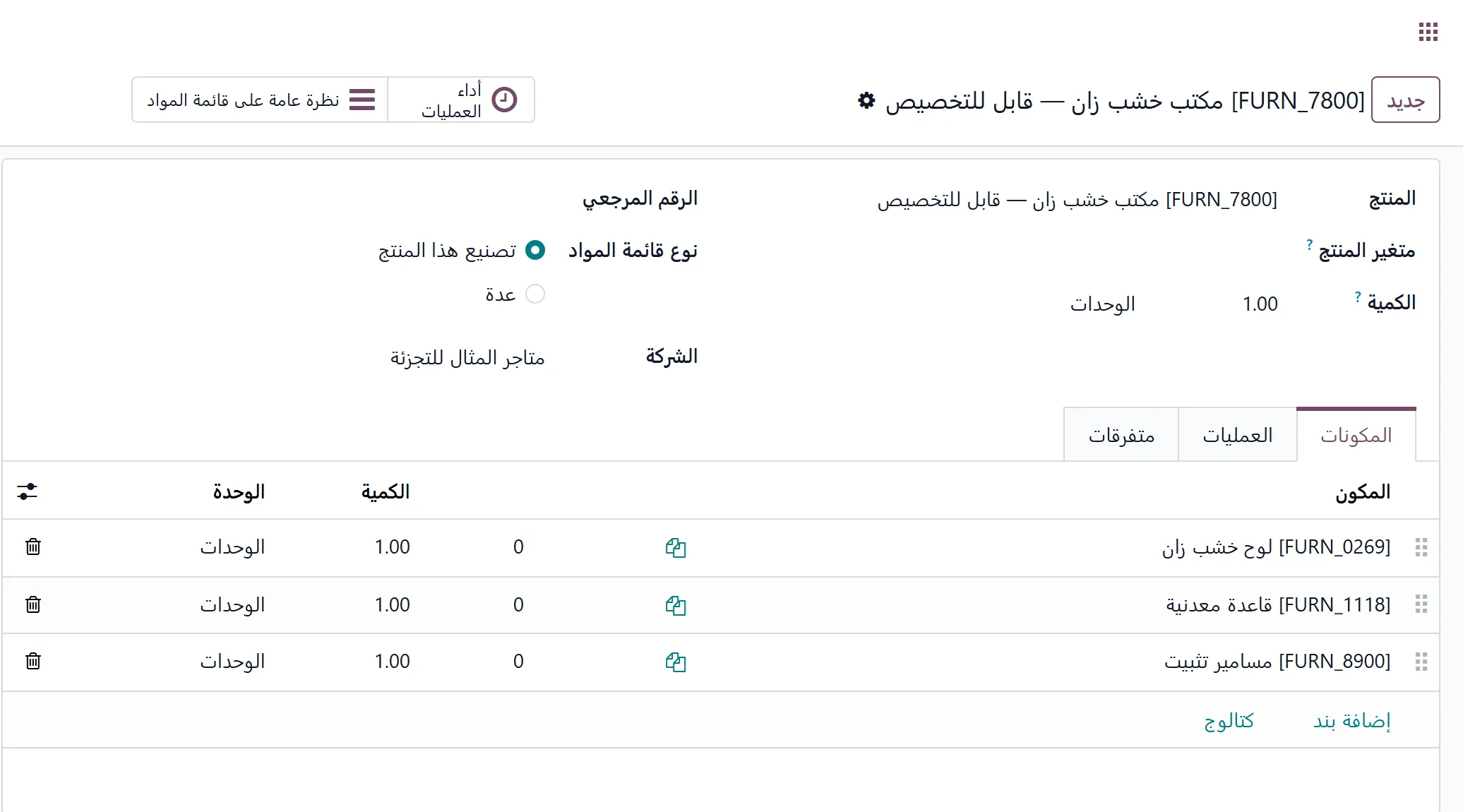
The cycle starts by defining what gets made, what it needs, and how it moves through the factory.
The product record covers:
The bill of materials (BoM)
The BoM states which materials and quantities the product needs, and what it yields: the finished product and any by-products.
An item can carry more than one BoM, depending on size, revision, or customer specification.
The standard recipe is not edited every time a different order shows up. The original stays intact. An approved change gets its own version or configuration.
The routing
The routing defines the operations the product passes through, for example:
Cutting → Forming → Assembly → Finishing → Inspection → Packing
Each operation has a work center, an expected time, a sequence, and an approval, and one operation may need to finish before the next can start.
That way the BoM is not just a list of materials; it is a complete description of how the product leaves the factory.
From the order to the production plan
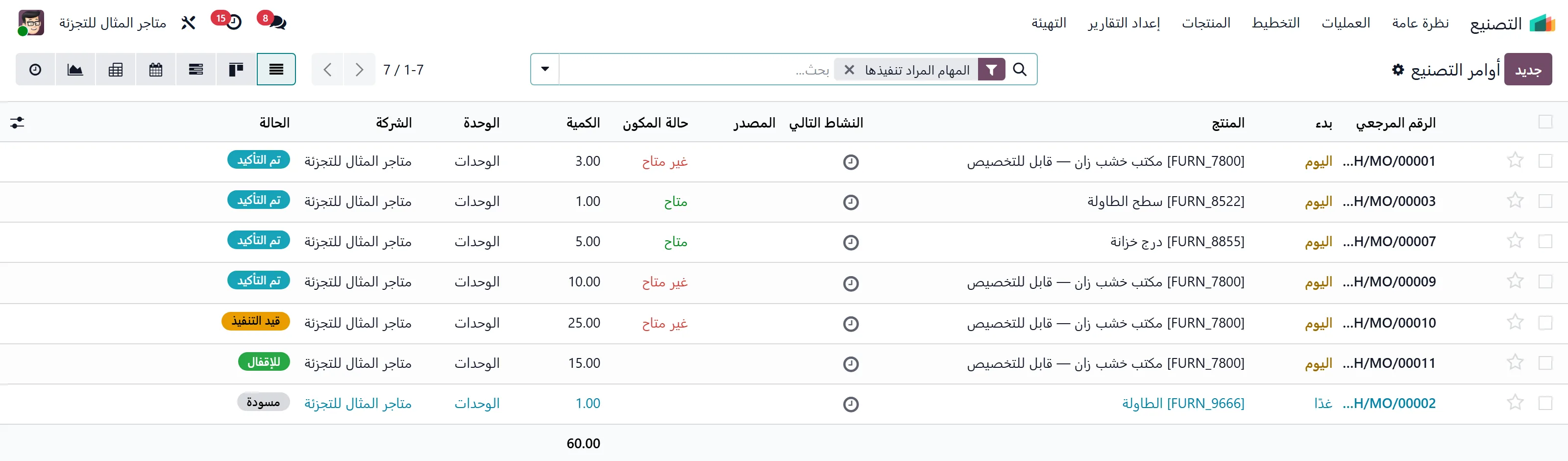
The need can start from a customer order, a stock dip, a sales plan, or a project with a delivery date.
The system gathers these requirements, then checks them against:
From there, the required production orders emerge, with their dates and priorities.
A material being on site is not enough. It may already be reserved for another manufacturing order. Planning therefore runs on what is available after reservations, not the gross balance alone.
Materials planning and purchasing
When a production order is confirmed, the system calculates the materials required and compares them to what is available.
Any shortfall surfaces to purchasing, with the quantities needed and the arrival date that keeps production starting on time.
Purchasing runs from the requisition to purchase order approval, then receipt, inspection, the vendor bill, and payment.
And every purchase ties back to a clear reason:
What a material really costs
A material's cost is not just the vendor's price.
On purchases and imports, freight, insurance, customs, transport, and other charges can be added to the shipment's cost, then spread across its items.
The material enters the factory at its true value, so a product never looks profitable just because part of its cost was left outside inventory.
Receiving materials
When materials arrive, the quantity received is matched against the purchase order, and any shortage, excess, or damage is recorded.
A material may pass through inspection before it becomes available to production.
Based on the result, it moves to:
In industries that need traceability, the lot or serial number and expiry date are recorded, so for every material you can trace the vendor, the shipment, and each product it went into.
Scheduling the factory
Once materials are confirmed, manufacturing orders are scheduled across the lines and work centers.
Scheduling depends on:
A production order can hold several work orders, so each department knows exactly what is expected of it: the quantity, the deadline, what comes before it, and what comes after.
A delay in one stage shows its effect on the following stages and the delivery date, instead of the problem surfacing only after the deadline has passed.
Execution on the shop floor
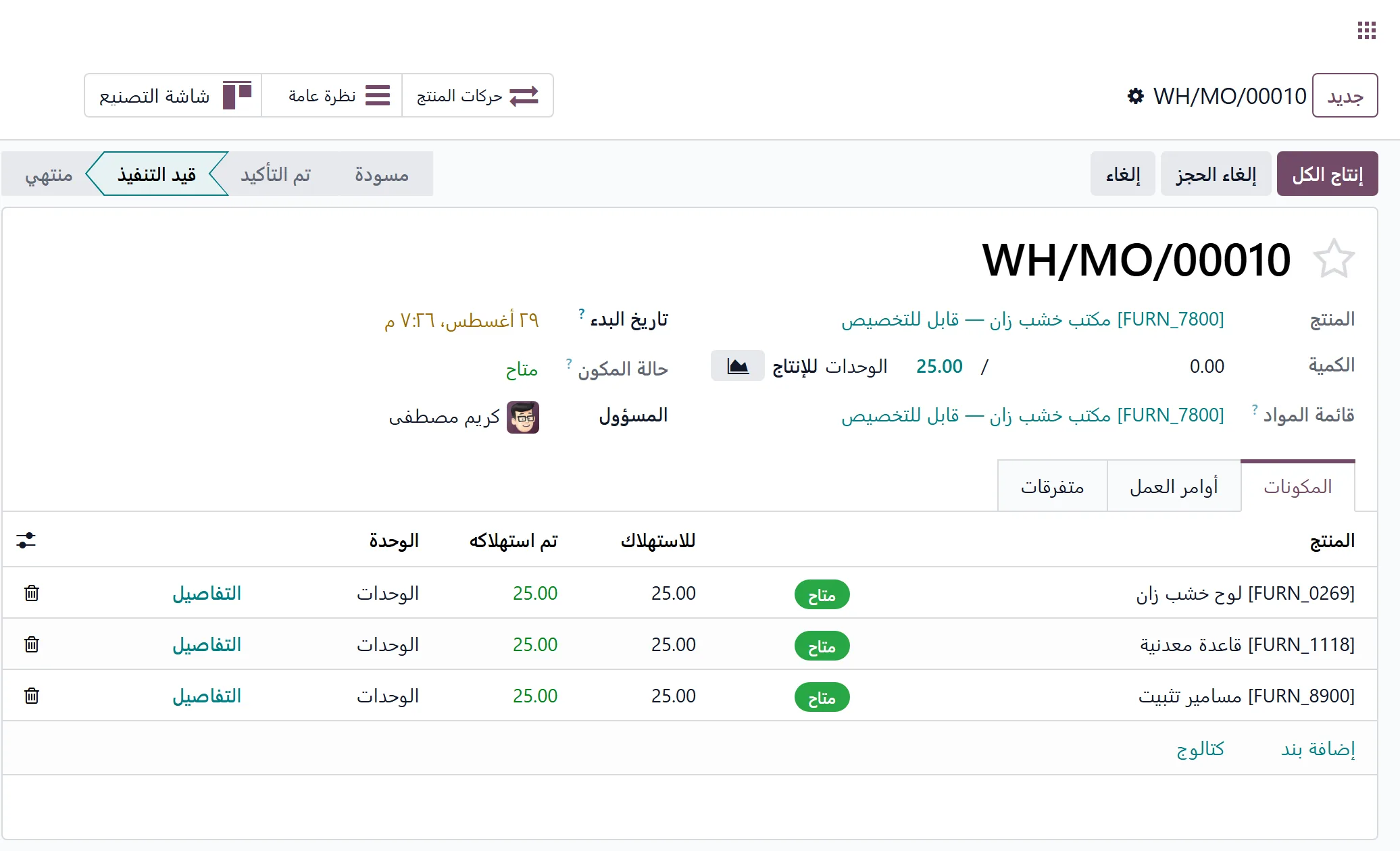
When a run starts, materials are issued to that specific manufacturing order, not as a general factory expense.
The production team records:
Actual quantities can differ from the theoretical BoM. The system keeps both, so expected consumption can be compared against what was actually used.
And nobody waits for the end of the shift to enter everything from memory or paper. That lag disconnects the system from what is actually happening on the floor.
Work in progress (WIP)
Materials that left the warehouse have not instantly become finished product.
They may be in cutting, in assembly, at an external subcontractor, waiting for inspection, or due for rework.
The system shows the quantities in progress, where they are, which stage they have reached, and how long they have been there.
So you can answer:
Quality is not just a final check
Quality can start at material receipt, repeat during production, then run once more before the finished product enters stock.
Check points can vary by product or operation:
When a check fails, the result does not sit as a note. The quantity moves down a defined path:
The failure reason, the stage, the machine, the vendor, the worker, and the photos stay attached to the case, so you can trace the defect to its source and stop it recurring.
Engineer to order (ETO)
With engineered or custom products, the factory does not start from a generic quotation.
The process usually runs:
Inquiry → Site visit & measurements → Design → Pricing → Customer approval → Contract → Technical review → Custom BoM → Manufacturing → Installation or handover
Each customer order is treated as its own project, holding:
Controlling changes
The most dangerous moment in engineer-to-order work is a design, dimension, or material changing after purchasing or production has already started.
So the system keeps clear revisions, and no change reaches the factory before it is approved and its impact is defined on:
That way the engineering office is never working on one revision while the factory builds another.
Subcontract manufacturing
When stages run at an external vendor or workshop, the materials and work in progress still belong to the company, and they must stay visible in the system.
The company may ship its materials to the external factory, or the intermediate product may move straight from one vendor to the next for the following stage.
The system tracks:
Even when a product passes through several factories, its trail stays connected from the first material to the finished product, instead of each stage showing up as a separate purchase that cannot be tied to what came before it.
Packing and the finished product
After manufacturing and inspection, a product may still need final assembly, a box, a label, or accessories.
Packing is treated as part of the manufacturing cycle whenever it consumes materials and changes the sellable form of the product.
Once complete, the finished product enters stock with its quantity, lot, and actual cost.
It then becomes available to the order it was made for, or to general stock, if it was made to stock.
A product never shows as available to sell before its operations, inspection, and packing are done.
Multiple plants and lines
When a company runs more than one plant or station, each site can operate with its own stock, lines, and production orders, while management stays on one system.
The sales order, the customer's region, or the product type determines which plant fulfills the order.
And each plant shows:
One system does not mean blended numbers. Each site stays visible on its own, and the company rolls up as a whole.
Installation and handover
In some industries, the cycle does not end at the factory gate: there is transport to schedule and installation at the customer's site.
The system ties the installation date to product readiness, the crew, the vehicle, the customer's location, and the payments due before work starts.
The installation team records:
New work is never added to the original order verbally. It gets recorded, and its impact on price, time, and cost is set before it is executed.
Once handover is complete, warranty or maintenance begins per the product policy and the contract.
Maintenance protects the production plan
One broken machine can delay several manufacturing orders, so maintenance is never managed apart from the factory plan.
The system keeps a record for every machine or asset, covering:
When a machine goes down, the impact shows on its work center and the orders scheduled on it, and the schedule can be rebuilt, instead of the plan carrying on as if the capacity were still there.
Product cost
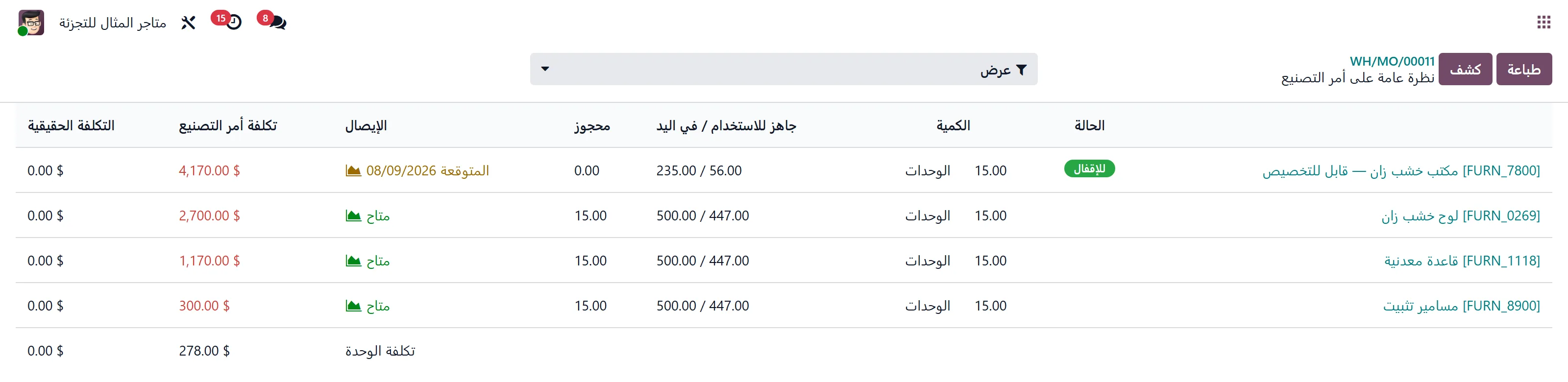
Manufacturing cost is not computed from theoretical materials alone.
Depending on the business, product cost is built from:
You can then compare:
Expected cost → Actual cost → The variance and its cause
In make-to-order work, cost accumulates on the customer order or project itself, so each order shows its own profitability, not just a product-wide average.
Repeat products follow the approved inventory valuation method (standard cost, average, or FIFO) per the company's nature and accounting policies.
How operations hit the books
Every completed movement in operations creates its financial impact at the source.
A purchase records the vendor liability. Receiving a material raises inventory value. Issuing it moves that value into work in progress. Finishing manufacturing moves the cost into finished goods. And the sale records revenue and cost of goods sold.
And each shows separately:
The accountant never has to rebuild product cost from purchasing, warehouse, and production files at month end. Those departments recorded each cost at its source, as it happened.
Who owns the decision?
One person may hold several roles depending on the factory's size, but every decision must have a clear owner.
| Role | Decisions they own |
|---|---|
| Sales / project management | The customer order, commercial specs, delivery date, and order priority. |
| Design & engineering office | Drawings, dimensions, revisions, the bill of materials, and technical specifications. |
| Production planning | Production orders, priorities, scheduling, and allocating work across lines. |
| Purchasing | Vendors, purchase orders, prices, and delivery dates. |
| Warehouse | Receiving, issuing, returns, transfers, inventory counts, and lot tracking. |
| Production supervisor | Starting work orders, assigning work, and logging output and stoppages. |
| Operator / machine worker | Running the operation and logging time, quantity, and notes within their access rights. |
| Quality | Inspection results, rejections, rework, and product release. |
| Maintenance | Preventive maintenance, breakdowns, spare parts, and machine readiness. |
| Cost Control | Expected vs. actual cost, variances, and order and project costing. |
| Finance | Vendors, inventory, work in progress, journal entries, valuation, and profitability. |
| Installation / delivery | Scheduling, site visits, work performed, and handover reports. |
- Decisions they own
- The customer order, commercial specs, delivery date, and order priority.
- Decisions they own
- Drawings, dimensions, revisions, the bill of materials, and technical specifications.
- Decisions they own
- Production orders, priorities, scheduling, and allocating work across lines.
- Decisions they own
- Vendors, purchase orders, prices, and delivery dates.
- Decisions they own
- Receiving, issuing, returns, transfers, inventory counts, and lot tracking.
- Decisions they own
- Starting work orders, assigning work, and logging output and stoppages.
- Decisions they own
- Running the operation and logging time, quantity, and notes within their access rights.
- Decisions they own
- Inspection results, rejections, rework, and product release.
- Decisions they own
- Preventive maintenance, breakdowns, spare parts, and machine readiness.
- Decisions they own
- Expected vs. actual cost, variances, and order and project costing.
- Decisions they own
- Vendors, inventory, work in progress, journal entries, valuation, and profitability.
- Decisions they own
- Scheduling, site visits, work performed, and handover reports.
Some decisions involve more than one department, but a single party still owns starting the decision and seeing it through.
Controls above the factory floor
Recording what was produced is not enough. Every change and every exception must be reviewable.
The system relies on:
Access rights and approvals
Define who can change a recipe, substitute a material, over-issue, approve scrap, move a production date, or close a manufacturing order.
Audit trail
Records who changed the data, when, the value before and after, and why.
Document versions
Keep design revisions, BoM versions, and work instructions in sync, so no department works from a different copy.
Stoppage and variance reasons
A delay or over-consumption is never logged as a bare difference; it is tied to a cause you can analyze: material, machine, quality, labor, or planning.
What does management track?
Factory metrics depend on connecting the order, the materials, production, quality, and cost.
The key indicators include:
What does Odoo actually run?
Odoo brings into one cycle: