
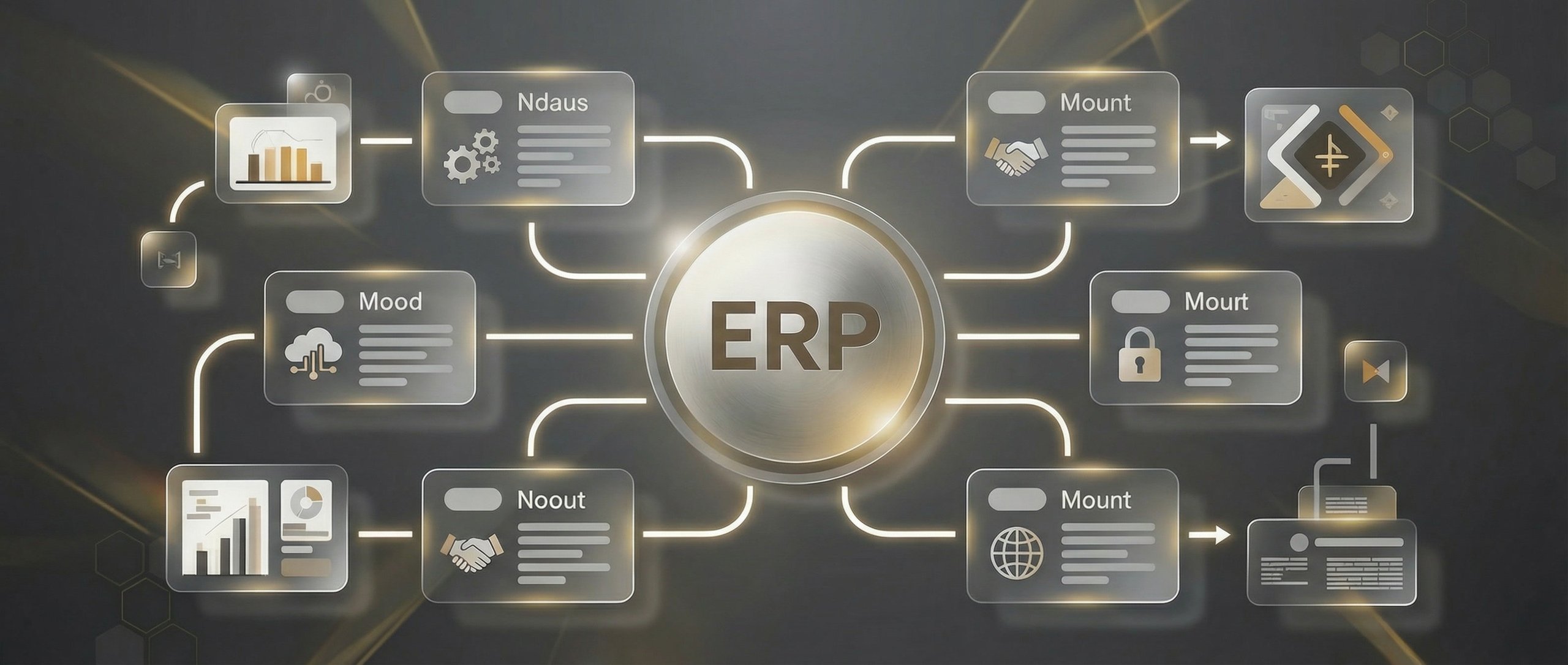
Growing companies face a familiar problem. Data lives in separate systems. Finance uses one tool, sales another, inventory a third. Reports require manual compilation. Decision-makers lack real-time visibility. As organizations expand, these disconnected processes become bottlenecks—slowing growth, increasing costs, and creating risk.
This fragmentation is not a technology problem alone. It is an operational one. When information does not flow freely across departments, teams duplicate work, miss opportunities, and make decisions based on incomplete data.
ERP addresses this at the foundation. It is the system that connects everything.
ERP stands for Enterprise Resource Planning. It is integrated software designed to manage the core operations of a business in one unified platform. Finance, sales, inventory, procurement, human resources, manufacturing—all connected through a single database.
Unlike disconnected applications, ERP provides a single source of truth. Data entered once flows everywhere it is needed. A sale in the system updates inventory, triggers fulfillment, records revenue, and notifies accounting—automatically. Teams work from the same information. Processes become consistent. Visibility becomes real.
This is not about replacing multiple tools with one tool. It is about creating an operational foundation where information moves freely and decisions rest on accurate data.
ERP delivers measurable impact across six core areas.
Saves time and cost. Automation eliminates manual tasks. System consolidation reduces overhead and licensing complexity.
Improves collaboration. Centralized data and workflows enable teams to work together without handoffs or delays.
Accurate reporting. Real-time, reliable data supports compliance, analysis, and audit requirements.
Scalable operations. The system grows with the business. New locations, new products, new teams—the platform adapts without requiring new tools.
Better customer service. Sales, support, and fulfillment are linked. Customer inquiries are answered faster. Orders are fulfilled accurately.
Stronger decision making. Executives see the full picture. Visibility across operations supports confident, informed choices.
Different industries apply ERP differently, but the principle remains the same—connecting operations into one reliable system.
Manufacturing uses ERP to track materials, production schedules, and quality control in real time. Bill of materials, work orders, and inventory are synchronized. Production managers see bottlenecks before they happen.
Retail and eCommerce integrate inventory across stores and online channels. POS systems, payment processing, and fulfillment are unified. A sale online updates warehouse stock instantly.
Professional services firms use ERP to manage project billing, resource allocation, and client contracts. Time tracking feeds directly into invoicing. Resource managers see capacity across projects.
Food and beverage companies manage batch production, compliance, and perishable inventory through ERP. Expiration dates, production runs, and regulatory requirements are tracked systematically.
Equipment rental businesses schedule assets, manage maintenance, and automate invoicing. Asset location, maintenance history, and rental terms are centralized.
Logistics and distribution companies optimize fleet management, warehousing, and delivery operations. Routes, inventory levels, and shipment status are visible in real time.
ERP is not software. It is a strategic foundation. Organizations that implement it well do not just reduce costs—they scale faster, adapt to market changes, and make better decisions. It is the operational backbone that separates companies that grow from companies that plateau.